



by Kelly KIRSCH Directeur Général ESG Europe
From sovereign AI to energy systems and biodiversity governance, the transition economy is no longer emerging—it is being built in real time.
A structural shift is underway across global markets—and it is accelerating.
For over a decade, ESG was framed as a lens: a way to assess risk, measure impact, and guide capital allocation. Today, that framing is no longer sufficient. ESG is evolving into something far more consequential:
👉 It is becoming the infrastructure of markets themselves.
This week’s developments illustrate that transformation with unusual clarity.
France is embedding industrial policy into renewable deployment. Europe is advancing sovereign AI capabilities through Mistral. Capital is consolidating into large-scale energy platforms across Asia. Canada is integrating biodiversity into fiscal policy. China is codifying environmental governance into enforceable law.
Across each of these domains, the pattern is consistent:
The transition economy is no longer about what should happen.
It is about what is being built—and who controls it.
France has announced a sweeping 12 GW renewable energy tender program, combining:
But the real story is not capacity—it is control.
This program embeds resilience criteria that prioritize European supply chains and limit dependence on foreign inputs, particularly from China. From turbine components to solar modules, procurement is now being reshaped around strategic autonomy.
This reflects a broader pivot:
👉 Energy transition is no longer just about decarbonization—it is about sovereignty.
At the same time, France is leveraging its nuclear baseline to maintain relatively low electricity prices, allowing it to expand renewables without compromising affordability—a critical balancing act across Europe.
We are entering an era of “geopoliticized ESG”.
Three structural dynamics are converging:
The implication:
👉 The lowest-cost solution is no longer always the optimal one.
Resilience, control, and political alignment now carry equal weight.
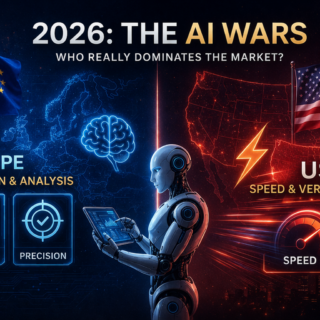
Artificial intelligence is no longer just a technology race—it is a geopolitical contest over control, data, and infrastructure.
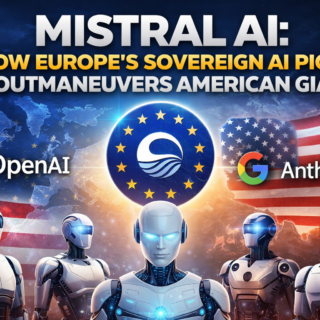
Within this landscape, Mistral AI has emerged as Europe’s most credible sovereign alternative to U.S. and Chinese dominance.
Founded in 2023, Mistral has rapidly secured government and institutional contracts across Europe, Africa, and the Middle East, including:
Its core proposition is fundamentally different from U.S. competitors:
👉 Sovereignty over scale.
Mistral offers:
This positions it as a political and strategic choice, not just a technical one.
Governments are increasingly prioritizing:
Mistral’s model aligns directly with these needs.
As President Emmanuel Macron stated:
👉 “Mistral is not just a technological choice—it’s a political one.”
Unlike the U.S. model (capital-intensive, closed, API-driven), Europe is experimenting with:
This creates a different kind of ecosystem:
👉 Less concentrated, more modular, and strategically autonomous
AI is rapidly becoming an ESG-critical infrastructure layer.
From an ESG perspective, three risks stand out:
1. Governance Risk (G)
Closed AI ecosystems concentrate power among a few private actors, creating systemic fragility.
2. Sovereignty Risk
Dependence on external AI infrastructure creates long-term strategic vulnerability for nations and institutions.
3. Economic Distribution Risk
Value capture is increasingly concentrated in infrastructure providers rather than users.
Europe’s approach—via Mistral—attempts to rebalance this dynamic.
A $2.2 billion joint venture between TotalEnergies and Masdar will scale 9 GW of renewables across Asia, spanning 9 countries.
This is not just expansion—it is platform consolidation.
The model combines:
And integrates:
👉 This signals a shift toward system-level energy deployment, not isolated projects.
Energy transition is becoming capital-intensive, consolidated, and platform-driven.
This creates:
Canada’s plan to protect 30% of land and oceans by 2030 marks a major shift in how biodiversity is positioned:
👉 Not as environmental protection—but as economic infrastructure
With:
The policy directly impacts:
We are entering the era of “nature-constrained economics.”
Biodiversity is now:
China’s new Ecological and Environmental Code transforms sustainability into binding legal infrastructure.
This creates:
The global ESG landscape is diverging:
China is choosing the latter.
What we are witnessing is not a transition.
It is a rewiring of the global economic system.
Across every sector, the same pattern is emerging:
The implication is profound:
👉 The future of markets will not be defined by growth alone—but by resilience, control, and alignment with systemic constraints.
In this new environment:
The winners of the next decade will not be those who adapt fastest to ESG frameworks.
They will be those who understand that:
👉 ESG is no longer a framework. It is the architecture of the next economy.
ESG.AI is now operating from Crédit Agricole’s Le Village Innovation Accelerator
📍 55 rue La Boétie, 75008 Paris
We are pleased to welcome Anastasia Paris to the ESG.AI Advisory Board.
As Head of Sustainability & ESG Performance at Groupe Crédit Agricole, Anastasia brings deep expertise across ESG strategy, regulatory frameworks, and sustainable finance.
Her experience includes:
Her addition strengthens ESG.AI’s ability to navigate and shape the future of ESG data, regulation, and financial innovation in Europe.
🌍 #ESG #Sustainability
⚡ #EnergyTransition #EnergySecurity
🤖 #AI #SovereignAI #AIInfrastructure
🏛️ #EURegulation #IndustrialPolicy
🌱 #Biodiversity #NatureFinance
📊 #SustainableFinance #TransitionEconomy
📈 #ESGAI #ClimateAnalytics
About ESG.AI
If your business is navigating these developments, ESG.AI can help you stay ahead. From automating SME reporting to managing climate‑risk portfolios and supporting renewable‑energy investments, our platform uses cutting‑edge AI to turn ESG challenges into opportunities. Let’s connect to discuss how.
At ESG.AI, we’ve built a platform specifically for companies navigating the fast‑evolving landscape of sustainability regulation and reporting. It’s the only solution currently mapped against all major global ESG standards, giving organizations a unified framework for compliance and insight.
What sets ESG.AI apart is its agentic AI core. Our technology doesn’t just collect data; it acts on it—tracking your ESG metrics in real time, simulating “what‑if” scenarios and drafting regulatory filings so you’re always ahead of new requirements. As regulations proliferate, this proactive intelligence turns ESG obligations into opportunities for differentiation and strategic growth.
Through our strategic alliance with the London Stock Exchange Group, we combine deep regulatory foresight with cutting‑edge AI innovation. Whether you’re reporting to investors or planning long‑term sustainability initiatives, ESG.AI equips you with the tools to manage risk, seize competitive advantage and lead confidently in the ESG era.
For inquiries or to request a free trial, contact Kelly.KIRSCH@esg.ai in English or French.
For more information on ESG.AI go to
and
ESG performance Analytics