




by Kelly KIRSCH
An ESG & Sustainable Finance Briefing powered by ESG.AI
A quiet but decisive shift is underway in global markets.
For much of the past decade, ESG has been defined by disclosure, commitments, and competing frameworks. Today, that phase is giving way to something more structural. Across jurisdictions, sustainability is being embedded into the systems that govern capital allocation, infrastructure development, and economic policy.
This week’s developments illustrate that transition with unusual clarity.
Europe is scaling offshore wind through increasingly sophisticated state-backed financial mechanisms. Artificial intelligence is no longer simply a digital capability, but an energy-intensive infrastructure shaping industrial strategy. Governments are tightening climate programmes and extending disclosure requirements deep into corporate value chains. Meanwhile, sustainable finance frameworks are moving from design to implementation.
Even in the United States, where ESG remains politically contested, regulatory momentum continues to build—driven less by ideology than by market demand for reliable, decision-useful data.
The common thread is unmistakable:
👉 ESG is shifting from narrative to measurement, from reporting to systems, and from ambition to execution.
This transition also raises an important question: if sustainability is becoming embedded in financial decision-making, how effectively are markets actually rewarding it?
📖 This question is explored in detail in a recent article by ESG.AI’s Directeur Général in Paris, Kelly Kirsch, which examines why strong sustainability performance does not always translate into higher ESG ratings—and what can be done to address that disconnect: 👉 https://esgnews.com/esg-ratings-why-strong-sustainability-efforts-arent-always-rewarded-and-how-to-fix-it/
It is a question that sits at the centre of the next phase of ESG.
The European Commission’s approval of Denmark’s €5 billion ($5.7 billion) offshore wind scheme represents more than a routine endorsement of renewable energy investment. It reflects a broader shift in how Europe is structuring the financial and regulatory foundations of its energy transition.
The programme enables the development of two large-scale offshore wind farms—Hesselø and North Sea I Mid—under a 20-year support framework aligned with the EU’s Clean Industrial Deal State Aid rules. Together, the projects will deliver nearly two gigawatts of capacity and produce close to eight terawatt-hours of electricity annually, equivalent to roughly a quarter of Denmark’s current consumption.
Such scale underscores the urgency of Europe’s 2030 climate targets. But the deeper significance lies in the financial architecture underpinning the scheme.
At its core is a two-way contract for difference (CfD) model, which is becoming the preferred mechanism for large-scale renewable deployment across Europe. By linking developer revenues to market prices—while capping excessive gains—the structure provides predictable returns for investors without disconnecting projects from market dynamics.
This balance is increasingly important. As capital costs rise and fiscal constraints tighten, governments are seeking mechanisms that de-risk investment without distorting price signals.
The Commission’s approval also reflects a growing alignment between industrial policy and climate objectives. State aid is no longer viewed as an exception, but as a tool to mobilise private capital at scale.
For Denmark, the projects reinforce its role as a North Sea energy hub, central to Europe’s efforts to reduce reliance on imported fossil fuels. For the EU, they provide a template for how large-scale infrastructure can be financed and delivered within a coordinated policy framework.
The Danish scheme highlights the evolution of Europe’s energy transition from policy ambition to financial engineering. The increasing reliance on CfD models suggests a maturing market in which risk-sharing mechanisms are becoming central to unlocking large-scale capital.
Investors and developers should closely monitor how CfD structures evolve across EU member states, as they are likely to define the economics of future renewable investments.
The global conversation around artificial intelligence continues to be dominated by scale—larger models, greater computational power, and the race for technological supremacy.
Yet beneath this narrative, a more subtle transformation is unfolding in Europe.
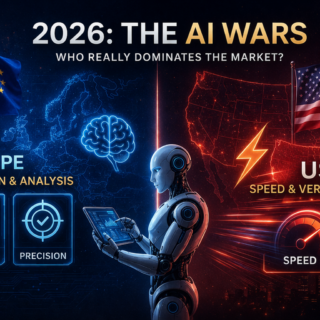
Rather than competing directly with U.S. hyperscalers in the development of frontier models, Europe is positioning itself around a different axis: 👉 precision, regulatory alignment, and real-world application.
An in-depth comparative analysis of leading AI systems in 2026—including Mistral, ChatGPT (GPT-5), Claude, Gemini, Perplexity, Grok, and Thales’ Dragon—reveals a fragmented but increasingly specialised ecosystem.
At the centre of this landscape is Mistral, Europe’s flagship model, which has gained traction in sectors where accuracy, data sovereignty, and compliance are critical. Its strength lies not in speed or general-purpose versatility, but in its ability to handle complex, domain-specific tasks such as legal analysis, engineering, and technical documentation.
This reflects a broader shift in how AI performance is evaluated.
While early adoption prioritised speed and accessibility, enterprise and institutional users are increasingly focused on:
· Precision
· Reliability
· Traceability
· Regulatory compliance
In this context, Europe’s approach offers distinct advantages.
Other models reinforce the diversity of the ecosystem:
· Claude is emerging as a leader in nuanced reasoning and ethical analysis
· Perplexity is redefining research through real-time, source-based outputs
· Gemini is advancing multimodal capabilities integrated into enterprise workflows
· Dragon (Thales) is addressing the needs of highly regulated sectors such as defence and aerospace
Rather than converging toward a single dominant model, the market is fragmenting into use-case-specific tools, each optimised for particular environments.
This fragmentation aligns with Europe’s economic structure.
Its fragmented markets, strong industrial base, and regulatory complexity have historically required companies to build adaptable systems. These capabilities are now being applied to AI deployment, particularly in sectors where integration and compliance are critical.
The result is a model of innovation that is less visible than hyperscale development, but potentially more durable.
AI is not being developed as a standalone product. It is being embedded into industrial processes, financial systems, and regulatory frameworks.
Europe’s AI trajectory suggests a shift from model-centric competition to application-driven value creation. From an ESG perspective, this may reduce concentration risk and align technological development more closely with real-economy needs.
For companies and investors, the key challenge is selecting AI systems that align with specific operational and regulatory requirements, rather than defaulting to general-purpose tools.
Germany’s €8 billion climate programme reflects growing urgency within Europe’s largest economy to close the gap between current emissions trajectories and legally binding targets.
With emissions reduced by approximately 48% from 1990 levels—short of the 65% target for 2030—the government is shifting toward a more interventionist policy framework.
The programme combines industrial decarbonisation, renewable expansion, consumer incentives, and land-use measures. A central focus is reducing dependence on imported fossil fuels while accelerating electrification across industry and transport.
The plan also includes measures to increase electric vehicle adoption and strengthen carbon sinks through forestry and soil management.
The timing is notable. Rising geopolitical tensions and volatility in global energy markets have reinforced the link between climate policy and energy security.
For businesses, the implications are increasingly direct. Regulatory expectations are tightening, while public funding is being channelled toward sectors aligned with transition objectives.
Germany’s approach reflects a broader shift across Europe from policy ambition to implementation discipline, with climate strategy increasingly integrated into industrial and economic policy.
Companies should reassess exposure to transition risk and align investment strategies with policy-supported sectors.
California’s move to define Scope 3 reporting under SB 253 represents one of the most significant expansions of corporate climate disclosure globally.
The regulation applies to companies with more than $1 billion in annual revenue and introduces mandatory reporting of indirect emissions across value chains from 2027.
The scale of the challenge is substantial.
Scope 3 emissions often account for the majority of a company’s carbon footprint, yet they are also the most difficult to measure. They span suppliers, logistics networks, product use, and end-of-life processes—areas largely outside direct corporate control.
To address this complexity, regulators have proposed multiple implementation pathways, balancing speed, accuracy, and feasibility. Each carries different cost and operational implications, with early estimates placing compliance costs at over $150,000 annually per company.
The broader significance lies in the extension of accountability.
Climate disclosure is no longer confined to corporate operations. It is becoming a value chain obligation.
Scope 3 regulation represents a structural expansion of ESG boundaries, increasing both transparency and operational complexity across global supply chains.
Companies should begin strengthening supplier engagement and data systems to prepare for more granular emissions reporting.
Australia’s release of guidance for taxonomy-aligned debt marks a transition from policy design to execution in sustainable finance.
The framework provides a standardised methodology for applying sustainability criteria to bond and loan markets, addressing a key challenge in global finance: inconsistent classification of sustainable activities.
Sustainable debt issuance in Australia reached $53.8 billion in 2025, reflecting continued investor demand. The new guidance aims to ensure that capital flows are aligned with credible, measurable criteria.
The move also reflects a broader global trend.
Taxonomies are no longer simply policy tools. They are becoming mechanisms for directing capital allocation.
Australia’s framework illustrates the evolution of sustainable finance toward standardisation and operational integration, with implications for global capital flows.
Investors should monitor how taxonomy alignment influences access to capital and valuation across sectors.
Across markets, the same pattern is emerging.
Sustainability is no longer peripheral. It is being built into the systems that determine how economies function.
Energy infrastructure, artificial intelligence, climate data, and financial regulation are converging into a single framework—one that increasingly defines how capital is allocated and risk is assessed.
Yet as this system evolves, an important tension remains.
If ESG is becoming central to decision-making, 👉 are the mechanisms used to evaluate sustainability keeping pace?
📖 This question is explored in depth by ESG.AI’s Directeur Général in Paris, Kelly Kirsch, in his recent analysis of ESG ratings and their limitations:
Because the next phase of ESG will not depend solely on better data or stronger regulation.
It will depend on whether markets can translate sustainability performance into credible, consistent, and actionable signals.
And ultimately:
the future of ESG will be defined not by what is disclosed— but by what is measured, trusted, and acted upon.
🌍 #ESG #Sustainability
⚡ #EnergyTransition #GridResilience #EnergyAccess
🤖 #AI #AIInfrastructure #AIGovernance
🏛️ #EURegulation #ClimateLaw #IndustrialPolicy
🏭 #CleanIndustry #MadeInEU #LowCarbonManufacturing
🌱 #ClimateFinance #SustainableFinance #TransitionRisk
📈 #ESGAI #ClimateAnalytics
ESG.AI is now operating from Crédit Agricole’s Le Village Innovation Accelerator, 📍 55 rue La Boétie, 75008 Paris. A vibrant ecosystem where startups and corporates co-create solutions for innovation and sustainability—strengthening our mission to transform ESG reporting with AI across Europe.
About ESG.AI
If your business is navigating these developments, ESG.AI can help you stay ahead. From automating SME reporting to managing climate‑risk portfolios and supporting renewable‑energy investments, our platform uses cutting‑edge AI to turn ESG challenges into opportunities. Let’s connect to discuss how.
At ESG.AI, we’ve built a platform specifically for companies navigating the fast‑evolving landscape of sustainability regulation and reporting. It’s the only solution currently mapped against all major global ESG standards, giving organizations a unified framework for compliance and insight.
What sets ESG.AI apart is its agentic AI core. Our technology doesn’t just collect data; it acts on it—tracking your ESG metrics in real time, simulating “what‑if” scenarios and drafting regulatory filings so you’re always ahead of new requirements. As regulations proliferate, this proactive intelligence turns ESG obligations into opportunities for differentiation and strategic growth.
Through our strategic alliance with the London Stock Exchange Group, we combine deep regulatory foresight with cutting‑edge AI innovation. Whether you’re reporting to investors or planning long‑term sustainability initiatives, ESG.AI equips you with the tools to manage risk, seize competitive advantage and lead confidently in the ESG era.
For inquiries or to request a free trial, contact Kelly.KIRSCH@esg.ai in English or French.
For more information on ESG.AI go to
and
ESG performance Analytics