




by Kelly KIRSCH-Directeur Général ESG Europe
The global ESG landscape is undergoing a structural transformation.
For much of the past decade, sustainability was driven by policy ambition, disclosure frameworks, and investor signaling. Today, that phase is ending. What is replacing it is far more consequential—and far less abstract.
We are entering the execution era of ESG, where capital allocation, infrastructure buildout, and geopolitical risk are converging into a single system.
This week’s developments illustrate that shift with unusual clarity:
The common thread is unmistakable:
ESG is no longer about measuring impact—it is about building the systems that determine it.
The European Commission’s AccelerateEU strategy marks one of the most significant inflection points in Europe’s energy policy in decades.
At its core, the initiative recognizes a hard truth:
energy dependence is economic vulnerability.
Recent geopolitical tensions have forced Europe to confront this reality in financial terms. The bloc has already absorbed €24 billion in additional energy import costs without any increase in supply—a stark illustration of exposure to external shocks.
AccelerateEU is designed as both a crisis response and a structural reset.
Historically, Europe’s energy policy has been fragmented across member states, often leading to inefficiencies and conflicting responses during periods of stress. The new framework aims to change that.
The Commission is introducing:
This is not just operational alignment—it is the creation of a continental energy management system.
Short-term measures focus on economic stability. Governments are being encouraged to deploy targeted interventions such as:
These tools are deliberately designed to be targeted and temporary, avoiding the fiscal overreach seen in previous crises.
But the long-term transformation is where the real significance lies.
The EU is doubling down on electrification as the central pillar of its energy transition.
A forthcoming Electrification Action Plan will define how industries, transport systems, and buildings shift away from fossil fuels toward electricity powered by renewables.
This shift is supported by:
The scale of the transition is immense. The Commission estimates that €660 billion annually will be required through 2030 to meet these objectives.
Public funding—while substantial—will not be enough. The strategy explicitly relies on mobilizing private capital, with a Clean Energy Investment Summit planned to align institutional investors with project pipelines.
AccelerateEU is not simply an energy policy—it is a reconfiguration of Europe’s economic architecture.
Energy security, industrial competitiveness, and climate objectives are now being addressed simultaneously, rather than sequentially.
Europe is redefining ESG as a systems-level discipline.
The transition is no longer about emissions reduction alone. It is about:
Electrification is emerging as the central organizing principle of this new model.
While Europe is focused on energy sovereignty, the United States is confronting a different challenge:
the hidden infrastructure costs of artificial intelligence.
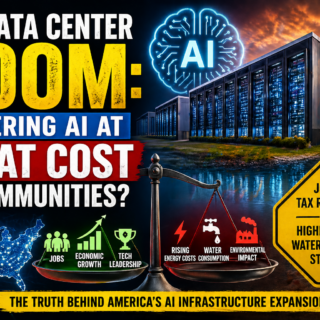
AI may appear digital, but its foundation is deeply physical. The rapid expansion of data centers across the U.S. is transforming landscapes, economies, and resource systems.
The numbers are striking:
A single hyperscale facility can require 1+ gigawatt of power, placing unprecedented strain on local grids.
Projections suggest data centers could soon account for 10–15% of total U.S. electricity demand—a level that fundamentally alters national energy dynamics.
Developers promote data centers as engines of economic growth:
But the reality is more nuanced.
While construction phases generate temporary employment, operational facilities typically require fewer than 50 permanent staff. This creates a mismatch between public expectations and long-term economic benefits.
At the same time, communities are facing:
This has triggered a growing backlash, with opposition emerging across political lines.
Energy is only part of the equation.
Data centers rely heavily on water for cooling, often in regions already facing scarcity. At scale, this creates localized environmental stress that is not fully captured in traditional ESG metrics.
The issue has become politically sensitive, with bipartisan concern over:
States are beginning to reconsider incentives, and some are exploring regulatory constraints on future development.
AI infrastructure is emerging as one of the most complex ESG risk categories.
It sits at the intersection of:
The key shift:
AI is not just a technological revolution—it is an infrastructure revolution.
Complementing AccelerateEU, the EU is advancing a more detailed push toward electrification as the foundation of its long-term strategy.
The Commission’s plan includes:
Electrification is no longer framed as a climate tool—it is positioned as a strategic economic advantage.
As Ursula von der Leyen emphasized, the goal is to create a system that is:
Electrification is becoming the clearest indicator of transition readiness.
Organizations that electrify early will:
The EU’s approval of €5 billion in climate-focused state aid highlights a critical evolution in transition strategy.
The focus is expanding beyond renewable generation to include:
Peatlands alone represent 7% of EU emissions, making them a high-impact target. Meanwhile, biomethane offers a scalable solution for sectors where electrification is more challenging.
The transition is becoming multi-layered:
This reflects a move toward full-system decarbonization.
Eiffel Investment Group’s new short-term green bond fund reflects a subtle but important shift in sustainable finance.
Investors are increasingly seeking:
The fund’s structure—short duration with strong green allocation—signals a move toward more flexible ESG investment strategies.
Sustainable finance is evolving from static allocation to dynamic capital management.
Green bonds are no longer just signaling tools—they are becoming core portfolio instruments.
This week’s developments reinforce a fundamental shift:
ESG is no longer a layer applied to the economy—it is becoming the architecture of the economy itself.
Energy systems, AI infrastructure, and capital markets are converging into a single, interconnected framework.
The implications are profound.
The next phase of the transition will not be defined by:
It will be defined by:
In this new reality, ESG is no longer about compliance or communication.
It is about control—over energy, infrastructure, data, and ultimately, economic outcomes.
And the organizations that understand this shift early will not just adapt.
They will lead.